To celebrate the International Day of Solidarity with the Palestinian People later this month, we’ve curated a collection of four films that capture the long plight of Palestinians. From MiniDV tapes of the Second Intifada (WITH HASAN IN GAZA) to reclaimed Palestinian archives (A FIDAI FILM) to modern-day frontline surgeries (A STATE OF PASSION) to stories of deaf Gazan children (VIBRATIONS FROM GAZA) to dramas from max-security Israeli prisons (3000 NIGHTS), this program chronicles a long history of genocide and resistance.
With Hasan in Gaza
Three MiniDV tapes of life in Gaza from 2001 were recently rediscovered. This footage now stands as a testament to a place and time that no longer exists. What began as a search for a former prison mate from 1989—a man lost to time and war—led to an unexpected road trip from the north to the south of Gaza, accompanied by Hasan, a local guide whose fate remains unknown. As the camera moves through Gaza’s streets and landscapes, it captures fleeting moments of everyday life—fragments of a reality now irreversibly altered. ‘With Hasan in Gaza’ transforms this forgotten footage into a cinematic reflection on memory, loss, and the passage of time—capturing a Gaza of the past, and lives that may never be found again.
A Fidai Film
Reel B75-92 shows scenes of orange-picking in Qalandia in 1957, which, according to the Hebrew description, are images of “terrorists”… They come from a collection of films and photos that were kept at the Palestine Research Centre in Beirut, until it was looted by the Israeli Army during the invasion of Southern Lebanon in 1982, and transferred to the archives of the Hebrew state’s army and Ministry of Defense. It was only in the 2010s that academic circles – in Tel Aviv, in particular – began to question the aims of this systematic plundering of the entire Palestinian visual memory, which became war booty in part renamed for ideological reasons: the occupying power de facto ensuring control of the captured material. In A Fidai Film, Kamal Aljafari(An Unusual Summer, VdR 2020) turns this primordial plundering against those who perpetrated it.
By revitalizing these lost images through his vibrant editing process, he unleashes the subversive power of a counter-narrative that has been erased over the decades, portraying life in Palestine before and after 1948 – particularly during the British mandate of the 1920s-1930s, when the tangible signs of future spoliation, humiliation and violence were already apparent. The Palestinian filmmaker thus meditates with a unique space-time depth of field on the fate of images produced by a people doubly dispossessed, both of its land, and of its history.
A Station of Passion
Dr Ghassan Abu Sittah, who was born a refugee, has volunteered in war zones across Palestine since the late 1980s. In October 2023, he entered Gaza to work at Al-Shifa and Al-Ahli hospitals during Israel’s bombing campaign. Over 43 harrowing days, he performed dozens of amputations, many of them on children, while hospitals were systematically destroyed and medical workers targeted. As food and supplies dwindled, and his own health deteriorated, Dr Abu Sittah was forced to return to the UK. Back home in the UK, he emerges as a powerful witness to the atrocities, bringing his first-hand experiences to the world stage, including the International Court of Justice. A State of Passion tells his story and, in the face of global inaction, articulately conveys the personal and collective trauma endured by the Palestinian population.
Vibrations from Gaza
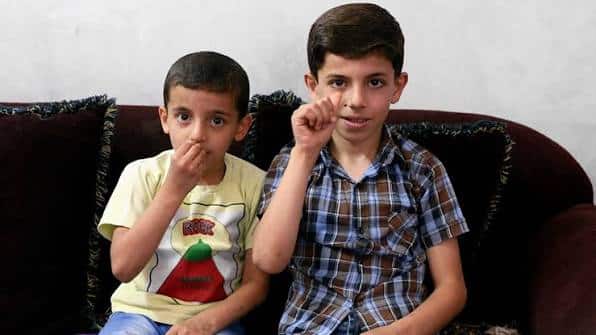
Vibrations from Gaza offers a glimpse into the experiences of Deaf children in the colonized and confined coastal territory of Gaza, Palestine. Born and raised under siege and frequent onslaughts these children, including Amani, Musa, Israa, and others, provide vivid accounts of their encounter of bombardment and the constant presence of drones in their sky. The children describe their perceptions of missiles strikes through sensing vibrations in the air, trembling of the ground, and the resonance of collapsing buildings. The film also questions whether the deafness of these children is a natural or a consequence of Israel’s use of sonic weaponry, such as sonic booms.