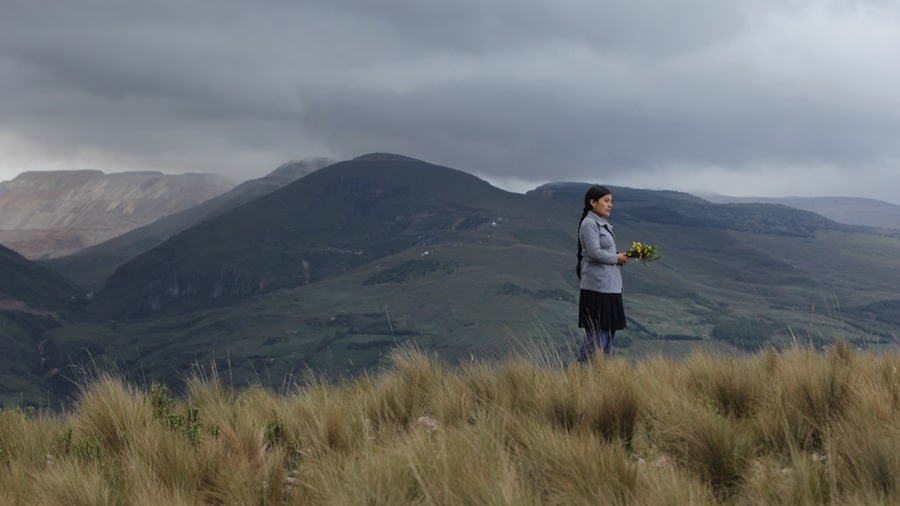
Water is the lynchpin of organic life, the cornerstone of all ecosystems. Yet despite its centrality to our planet, water remains a precarious resource in need of defense from extractive industries. To celebrate World Water Day, we’ve curated a program of three titles that advocate for the sanctity of water. These films span from protests against Ontario landfill sites (WATER ON THE TABLE) to a nation-wide water solidarity march in Peru (DAUGHTER OF THE LAKE) to community mobilization in defense of freshwater preservation in Colombia (CRUDE GOLD: THE CASE OF ECO ORO).
Water on the Table
WATER ON THE TABLE is a character-driven, social-issue documentary by Liz Marshall that explores Canada’s relationship to its freshwater, arguably its most precious natural resource. The film asks the question: is water a commercial good like running shoes or Coca-Cola? Or, is water a human right like air?
WATER ON THE TABLE features Maude Barlow, who is considered an “international water-warrior” for her crusade to have water declared a human right. ”Water must be declared a public trust and a human right that belongs to the people, the ecosystem and the future, and preserved for all time and practice in law. Clean water must be delivered as a public service, not a profitable commodity.” The film intimately captures the public face of Maude Barlow as well as the unscripted woman behind the scenes. The camera shadows her life on the road in Canada and the United States over the course of a year as she leads an unrelenting schedule. From 2008 – 2009 Barlow served as the U.N. Senior Advisor on Water to Father Miguel d’Escoto Brockmann, President of the 63rd Session of the United Nations.
But, WATER ON THE TABLE is more than a portrait of an activist … It is a poetic-essay that presents several dramatic and artfully crafted debates. Barlow’s opponents are giants in the world of policy and economics and they argue that water is no different than any other resource, and that the best way to protect freshwater is to privatize it. It is proposed that Canada bulk-export its water to the United States, imminently. Cinematic haiku-style images by Steve Cosens linger on watersheds, wetlands, rivers, estuaries, waterfalls and lakes, bridging themes and questions and elevating water beyond the political framework explored. While many embrace Barlow as a leader in the global water justice movement, others regard her as an alarmist and agitator. She became involved with the issue of Canada’s water in the mid-1980s, when it became clear that it was to be included as a tradable good in the Canada -US Free Trade Agreement. She tried very hard to get it removed, then stayed involved in the fight for Canada’s water when it was included in NAFTA as not only a good, but also as an investment. Water has since defined her.
Daughter of the Lake
Nelida is an Andean woman able to communicate with nature’s spirits. She feels she is the daughter of the lakes that provide water to her village. But just beneath her lakes, Yanacocha, Latin America’s largest gold mine, has discovered a deposit valued at billions of dollars. They have the Peruvian government’s support to mine it, even though it means drying out the lakes.
Farmers who live downstream oppose the project, because they fear running out of water. It’s a life and death struggle. The police have killed five men during the protests and the farmers not only have to confront the political and economic powers, but also the people in their communities who now depend on the small jobs the mine has given them. When Nelida joins the march from her homeland to Lima, the country’s capital, over a thousand kilometers away, she realizes she’s not alone. There are thousands of people who want to protect the Andean water sources.
Nelida’s story has parallels in Bolivia too, where a group of women live on dried out land. Their water disappeared after years of incessant mining. Then there is Bibi, a Dutch jeweler who exhibits her pieces on spectacular catwalks in Europe and who decides to visit Peru to discover the origin of the gold she uses.
Back in Peru, again, there is retaliation against the protesters. Marco, an ex-priest and Nelida’s mentor, is brutally detained by police whilst sitting in a public square, demonstrating peacefully.
The conflict goes on. We see how, in front of 150 policemen about to evict a peaceful protest at the lakes, Nelida grabs a phone and communicates with journalists in the city of Cajamarca. Her determination prevents a brutal attack. But her participation in these demonstrations has consequences: Nelida’s father, who works for the mine, loses his job.
But this doesn’t change her determination. She goes back to the lakes and prays to the water spirits. She makes them an offering of flowers and the photos of the five farmers killed during this seemingly endless conflict. Finally, Nelida asks her mother for the strength to keep going in her struggle for justice.
Crude Gold: The Case of Eco Oro
This film is part of the CRUDE GOLD series. The Santurban paramo has become an example of community struggle to protect water sources successfully. Lawyers, community leaders and activists united to mobilized and demanded the protection of natural resources threatened by Vancouver-based Eco Oro projects. A palpable urgency surrounds this story because of the fragility of the paramo – high-altitude wetlands – which supplies fresh water to the vast regions around Bucaramanga.